

15 Front Yard Landscaping Ideas for homes in Ontario
As a landscape designer in Toronto, I've helped countless homeowners improve their curb appeal. Creating a stunning front yard can have a significant impact on the value and beauty of your home. From years of hands-on experience, I’ve gathered several front yard landscaping ideas perfect for Toronto's climate and urban settings.
Plants for High-Impact Landscaping
Choosing beautiful plants is one of the easiest ways to create an appealing front yard. Whether that means trees, shrubs, perennials, pollinator plants, or native plants like Purple Coneflower or Canada Anemone that naturally thrive in Toronto’s climate. According to the Toronto Region Conservation Authority, native plants require significantly less maintenance, reducing your gardening expenses and supporting local biodiversity (TRCA, 2022). Choosing plants appropriately for their environment is key to their success. Always be mindful if they need shade or sun. They may start small but how much space will they need full grown. Are they drought tolerant or need to be well watered?

Native Plants for High Impact Landscaping
Creative Pathways and Borders
Creating clear pathways is a simple yet highly effective landscaping upgrade. Pathways inform you how to move around in your landscape. They can be attractive and welcoming. There are many options that range from natural stone to man made pavers to a simple pea gravel pathway. Edge paths with plants to add texture and color. Mulching these borders can reduce weed growth and conserve water, further saving on landscaping expenses.

A variety of materials like flagstone, pea gravel, pavers, or wood create beautiful pathways directing you through your outdoor spaces.
Evergreens for Year-Round INTEREST
Evergreens are a worthwhile investment that add lasting beauty and structure to your front yard. Evergreens range from Cedar to Fir to Pine to Spruce to Hemlock to Yew. In addition there are flatleaf evergreens like Euonymus, Inkberry Holly and Rhododendron. A new Cedar for hedging is called the ‘Green Giant’ and is fast growing and maintains a vibrant green appearance throughout Toronto's harsh winter environment, offering excellent durability and minimal upkeep. Inkberry Holly is a great substitution for Boxwood to create structured shrubs or lower hedges and isn’t susceptible to the Box Moth or Box Blight both of which are destroying plants in Toronto.

Evergreens in different shapes and sizes add beauty and year round interest in the garden.
Ornamental Grasses for Visual AND AUDITORY Interest
Ornamental grasses like Fountain Grass or Fescue or Maiden Grass or Oat Grass are perfect for sunny, dry spots in the garden. They offer a graceful, sophisticated aesthetic and work in modern or cottage style gardens. These plants thrive in Toronto’s climate, providing attractive foliage and year-round texture. In Winter they add an auditory experience as they rustle in the wind. They're ideal for filling large spaces, creating privacy screens, or simply adding movement and depth to your front yard landscape. For shady spots in your garden, try Japanese Forest Grasses.

A variety of different grasses for sun and shade gardens.
Trees to Boost Curb Appeal
Trees not only enhance curb appeal but significantly increase property value. According to Landscape Ontario, thoughtfully chosen and well-maintained trees can raise home values by as much as 20% (Landscape Ontario, 2021). Red Maple trees are particularly popular due to their vibrant fall colors, quick growth, and adaptability to Toronto's varying soil conditions. Other choices for smaller trees are the Flowering Dogwood, Redbud, Serviceberry and Magnolia. They offer beautiful spring blossoms and add elegance to your front yard landscape. To punctuate spaces, hedge along a property line or group, deciduous columnar trees are a great choice and are available as a Hornbeam, Beech, Birch, Oak, and Maple. Lastly, what is known as a ‘Standard’ tree form is a shrub like a Hydrangea or a Euonymus or Lilac that is grafted to a host tree trunk to elevate it into the air adding height to your landscape.
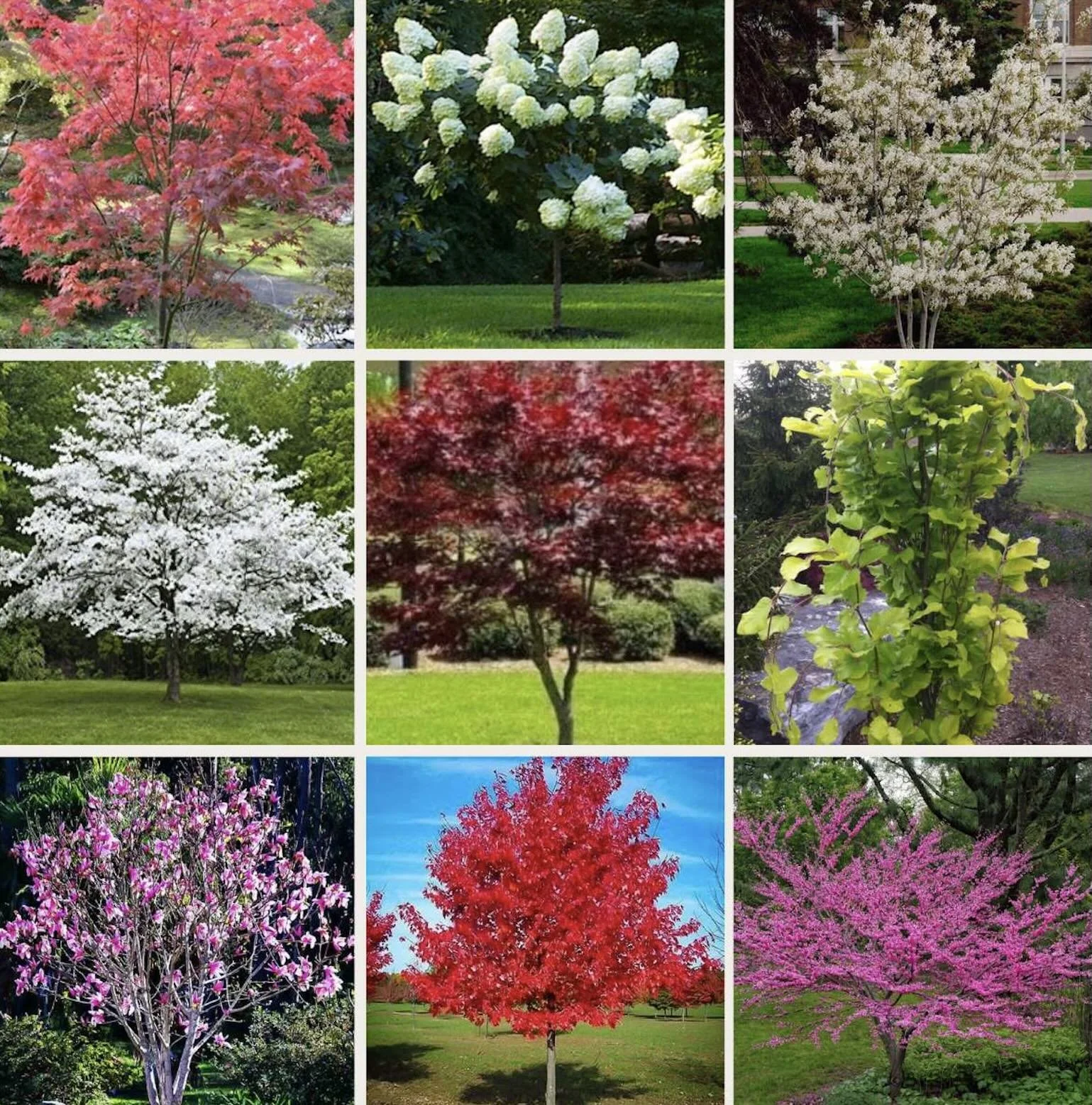
Different types of trees to make an impact and improve curb appeal.
Low-Maintenance Flower Beds
Flower beds filled with easy to care for plants dramatically enhance your home's curb appeal. Perennial Geranium, Catmint and Japanese Anemone are great choices for sunny spots. They’re resilient and provide vibrant blooms throughout Toronto’s growing season. Incorporating drought-resistant perennials like lavender and sedum into these beds ensures minimal watering, reducing both maintenance efforts and costs significantly. For shady gardens, consider Heuchera, Hosta and Astilbe. And of course if you do want to use Hydrangea, stick with the panicle varieties, or think outside the box and try Summersweet!

Perennials are great plants, in shade or sun, to plant for minimal care, and bring an amazing appeal to your yard throughout the year.
Ground Covers for Beauty
Hardy ground covers like Creeping Thyme or Ajuga provide effective weed suppression or can be naturalized around flagstone or pavers.. These plants flourish in Toronto’s climate, reducing your lawn care and watering needs. They’re especially useful in challenging areas, such as slopes or shaded spaces under larger trees, providing greenery without the extensive effort of traditional lawns.

Ground cover for sunny and shady spots in the garden.
Lighting for SAFETY AND Enhanced Evening Appeal
Adding lighting to your landscape is the jewelry to your landscape. LED lighting uses minimal energy but adds a gorgeous effect at night to highlight trees, light pathways for easier navigation and keeps your landscapes illuminated for safety. LED lighting is installed at the same time as an irrigation system and is set on a timer which can now can be controlled from your mobile device. Other options for lighting include solar-powered lights, overhead string lights or battery powered lanterns. Whatever option you choose, lighting will offer your landscapes ambiance and improve your home’s curb appeal.

Lighting to highlight plants in the garden and illuminate pathways.
Sustainable Design Practices
Implementing sustainable landscapes is a focus in the landscaping industry. For homeowners, this means choosing plants and materials that are environmentally friendly. This can mean something as simple as planting native plants, paving surfaces that allow for better drainage or composting for added nutrients for your soil. Rain gardens and rain barrels reduce water runoff, lower your water bill, and protect Toronto's waterways. According to Toronto's RainSmart program, rain gardens can manage up to 30% more stormwater compared to traditional landscapes, cutting costs while promoting sustainability (Toronto Water, 2020).
Planning for Year-Round Appeal
Toronto's seasonal shifts offer the chance to showcase year-round interest in your garden spaces. Paying attention to the details of each plant means you can ensure different plants bloom sequentially, providing continuous color and texture throughout the year. Combining these with evergreen trees and shrubs offers up green in the landscape through the Winter months when other plants are dormant. Leave room for annuals in your garden beds or as I suggest, use pots framing your front door to change up annual plants through spring, summer and fall.
Pair Your Lawn With Layered Garden Beds
One of the most common questions I hear from Toronto homeowners is whether they should keep their front lawn or replace it entirely. My answer? You don't have to choose. Some of the most striking front yards I've designed pair a smaller, healthier lawn with deep, layered garden beds around it. Here's the approach: shrink the lawn to a simple, well-defined shape — a crisp rectangle or a gentle curve — and let generous planting beds do the talking around its edges. A lawn framed by layers of shrubs, perennials, and ornamental grasses looks intentional and designed, while a wall-to-wall lawn just looks unfinished. A few combinations that work beautifully in our climate:
- A ribbon of lawn bordered by Catmint and Perennial Geranium, backed by Panicle Hydrangeas for height
- A circular lawn panel surrounded by low Inkberry Holly hedging — a classic look for Etobicoke's traditional homes
- A narrow lawn path running between two deep beds of ornamental grasses and Coneflowers for a more modern, naturalistic feel
The bonus: less lawn means less mowing, less watering, and a front yard that has colour and structure in every season — not just July.
Small Front Yard? Think Like a Designer
Many Toronto homes — especially in older neighbourhoods like Roncesvalles, Leslieville, and parts of Etobicoke — have front yards that are barely a few metres deep. Small doesn't mean skip it. A small front yard is actually easier to make spectacular, because every choice carries more weight.
My rules for small front yards:
- Choose one specimen plant as the star — a Serviceberry, a dwarf Japanese Maple, or a Standard Hydrangea — and let everything else support it
- Skip the lawn entirely if it's under a few square metres; replace it with a ground cover like Creeping Thyme and a generous stone landing
- Go vertical: a climbing Clematis on a simple trellis beside the door adds height without eating precious floor space
- Repeat two or three plants rather than collecting one of everything — repetition reads as calm and intentional in a tight space
- Oversize one element (a wide walkway, a large planter at the door). It feels counterintuitive, but one generous gesture makes a small space feel bigger, not smaller
Make an Entrance with Statement Planters
Your front door is the natural focal point of your home, and a pair of well-planted containers is the fastest curb appeal upgrade there is — no digging required.
The classic designer formula is "thriller, filler, spiller": one tall architectural plant for drama, mid-height plants to fill the body, and trailing plants to soften the edges. In our climate, the real trick is planning all four seasons: spring bulbs and pansies, lush summer tropicals or annuals, ornamental kale and grasses for fall, then birch branches, Magnolia tips and evergreen boughs for winter. One pair of quality planters, four completely different looks a year.
Scale matters more than people think — a planter that looks huge in the garden centre usually looks right at home beside a front door. When in doubt, go a size up.
Define the Edges: Driveway Borders and Front Walk Upgrades
The transition zones — where your driveway meets the garden, where the public sidewalk meets your property — are where most front yards quietly fall apart. Defining these edges is one of the most cost-effective upgrades I recommend.
A single course of natural stone or pavers along the driveway instantly makes the whole property look finished. Widening a builder-basic front walk from the standard 90 cm to 1.2–1.5 m transforms how welcoming the entrance feels — two people can walk side by side to your door. And if your existing concrete walk is sound but tired, a border band of contrasting stone can refresh it without full replacement.
For sloped front yards, common across Toronto's ravine neighbourhoods, a low natural stone retaining wall does double duty: it solves the grade and creates a raised planting bed that puts your garden on display.
Rethink the Lawn Entirely: Low-Water Front Yard Alternatives
More of my Toronto clients than ever are asking about reducing or replacing their front lawns — for lower maintenance, lower water bills, and more biodiversity. Done thoughtfully, a lawn-free front yard can be the most beautiful one on the street.
Options that thrive here:
- A meadow-style planting of native perennials and grasses — Coneflower, Black-Eyed Susan, Little Bluestem — that supports pollinators and needs no irrigation once established
- A structured gravel garden in the European style: crushed stone with drought-tolerant plants like Lavender, Sedum, and Russian Sage growing through it
- Massed ground covers punctuated by boulders and a specimen tree for a clean, modern look
One note of caution: "no lawn" doesn't mean "no design." A yard of mulch and a few shrubs reads as neglected; a composed alternative planting reads as intentional. The difference is structure — clear edges, repeated plants, and year-round anchors like evergreens and stone.
Front Yard Landscaping Questions I Hear Most Often
How much does front yard landscaping cost in Toronto?
Most full front yard landscaping projects in Toronto fall somewhere between $5,000 and $25,000+, depending on the size of the space and how much hardscaping is involved. Plant-focused refreshes can come in well under that; projects with new walkways, retaining walls, or extensive stonework sit at the higher end. My landscape designs start at $1,500, and an in-person consultation is $150 — I'm always upfront about pricing so you can plan with confidence.
What is the most low-maintenance front yard landscaping?
Native and drought-tolerant perennials, evergreen structure, and generous mulched beds. A front yard built on plants suited to Toronto's climate — rather than plants fighting it — needs a fraction of the watering, feeding, and fussing. If you want the lowest-maintenance yard possible, shrink or eliminate the lawn: it's the single most demanding thing in most front yards.
When is the best time to start a landscaping project in Ontario?
Design in winter, build in spring or fall. I book design work year-round, and having your plan ready by March means you're first in line when contractors' spring schedules open. Planting is best in spring (May–June) or early fall (September–October), when cooler temperatures and reliable rain help plants establish.
Do I need a permit for front yard landscaping in Toronto?
Most planting and garden bed work needs no permit. You may need one for retaining walls over a certain height, work near protected trees (Toronto's private tree bylaw protects trees 30 cm in diameter and up), or changes affecting drainage and grading. Part of my design service is preparing permit documentation and handling City approvals, so nothing stalls your project.
How do I add curb appeal on a budget?
Three things, in order: define your edges (crisp bed lines and mulch), upgrade the front-door moment (planters, house numbers, lighting), and add one specimen plant with four-season presence. You can do all three for less than the cost of resodding a lawn — and the impact is bigger.
Why Choose Master in the Field Landscape Design for Your Front Yard Makeover?
As a professional Landscape Designer with extensive experience serving Toronto homeowners, I understand local climate challenges and how to best bridge the gap between science and art. My job is to consider your landscape, your style preferences and your wish list and create a vision for your outdoor spaces. Each recommendation I make is rooted in sustainable, practical, and beautiful landscaping solutions that will improve your property value and transform the way you live outdoors!
Ready to transform your front yard affordably? Contact me today for personalized landscaping ideas tailored to your needs. PLUS…visit my Inspiration Page for more front yard landscaping ideas perfect for your Toronto landscaping projects.
References:
Landscape Ontario. (2021). Increasing Property Values Through Landscaping.
Toronto Water. (2020). A COMPLETE GUIDE TO BUILDING AND MAINTAINING A RAIN GARDEN. Your front door is the natural focal point of your home, and a pair of
well-planted containers is the fastest curb appeal upgrade there is — no
digging required.
The classic designer formula is "thriller, filler, spiller": one tall
architectural plant for drama, mid-height plants to fill the body, and
trailing plants to soften the edges. In our climate, the real trick is
planning all four seasons: spring bulbs and pansies, lush summer tropicals
or annuals, ornamental kale and grasses for fall, then birch branches,
Magnolia tips and evergreen boughs for winter. One pair of quality planters,
four completely different looks a year.
Scale matters more than people think — a planter that looks huge in the
garden centre usually looks right at home beside a front door. When in
doubt, go a size up.
